Corneal suturing is the one skill every ophthalmic surgeon needs and almost nobody gets to rehearse often enough: a 10/0 nylon bite at 90 percent depth, radial, evenly spaced, with a knot that buries. This guide shows how to practise it on the Eye 4 Layered Cornea, from the first interrupted suture to traumatic wound repair and the steps of a penetrating keratoplasty, and what a station costs to set up.
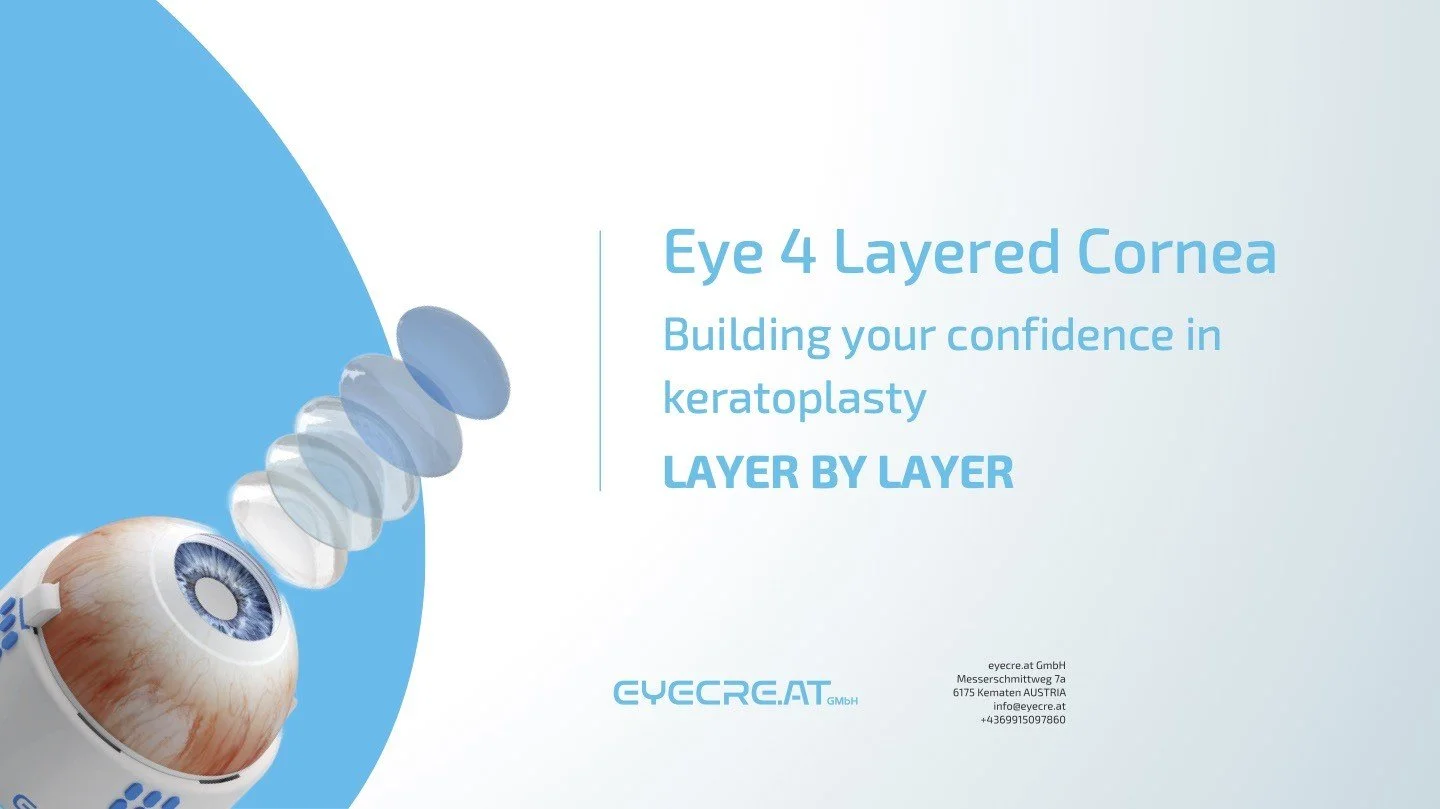
The Eye 4 Layered Cornea is an artificial training eye made in Austria with a cornea built from five separate layers (epithelium, Bowman's layer, stroma, Descemet's membrane, endothelium) that continue into sclera and conjunctiva. Because the layers are distinct, you can see and feel suture depth, open and close lamellar wounds, simulate corneal and corneoscleral trauma, and practise trephination and graft suturing for keratoplasty. One eye costs 99 euros (pack of 6), a donor cornea 19 euros, and residents can order a single eye through the Residents and Fellows programme. Everything ships directly from Tyrol, usually within 1 to 5 days.
Why corneal suturing deserves its own practice model
Most ophthalmic sutures are small, but corneal sutures are unforgiving. A bite that is too shallow gapes and leaks, one that is full thickness opens a path into the anterior chamber, and uneven tension writes itself into the patient's astigmatism for months. Surgeons learn this on wound closures after cataract surgery, on traumatic lacerations that arrive at night, and on keratoplasties where sixteen sutures have to be placed with the same depth and the same tension.[1]
The usual answer is the pig eye wetlab. It works, but it comes with a cold chain, a biological waste bin, tissue that is thicker and softer than a human cornea, and a lab that not every department has. A suturing pad is the opposite: always available, but flat, and without the curvature, the chamber behind the cornea and the limbus that make corneal suturing what it is.
The Eye 4 Layered Cornea sits between the two. It is a full artificial globe with a layered cornea, so it can be held in a standard holder, placed under the microscope, and sutured with the same 10/0 nylon, needle holder and tying forceps as in the OR. And because it is shelf-stable, it can be practised on at home or in a residents' room at 9 pm, which is when most suturing practice actually happens.
The Eye 4 Layered Cornea at a glance
| What it is | Artificial training eye with a five-layer cornea that continues into limbus, sclera and conjunctiva. Made in Austria by eyecre.at. |
|---|---|
| Layers | Epithelium, Bowman's layer, stroma, Descemet's membrane, endothelium, built as separate layers that can be identified, dissected and sutured individually |
| Procedures | Corneal suturing (interrupted, continuous, mattress), wound construction and closure, traumatic corneal and corneoscleral laceration repair, trephination, PKP, DALK, DSAEK, DMEK, ICRS implantation |
| Donor tissue | Donor 4 Layered Cornea, 19 euros per unit, one per transplantation exercise[3] |
| Price | 99 euros per eye, sold as a pack of 6 (594 euros). Single eyes for residents and fellows through the Residents and Fellows programme.[2] |
| Holders | PadPro 4 Eye, Set Pad 4 Eyes, Head 4 Eyes, Angle Retainer 4 Eye, Reusable System 4 Eye |
| Sutures and instruments | Sutures 4 Practice (10/0 nylon for cornea), Instruments 4 Practice (micro needle holder, tying forceps, Colibri forceps, corneal transplant scissors, radial suture marker), Knives 4 Practice, corneal trephine 7.5 mm |
| Shipping | Directly from Tyrol, Austria, worldwide. Delivery to most countries in 1 to 5 days when in stock; allow about 2 weeks for production on larger orders. |
Five layers, and what each one does for your practice
A human cornea is about 0.5 mm thick, and three of its five layers are thinner than a sheet of paper. In the training eye the thin layers are built thicker than in life, so that they can be seen under the microscope, grasped with forceps and peeled or dissected as a separate structure. That is a deliberate choice: a model whose Descemet's membrane is 10 micrometres thick would be anatomically correct and useless for learning what a Descemet's membrane feels like.
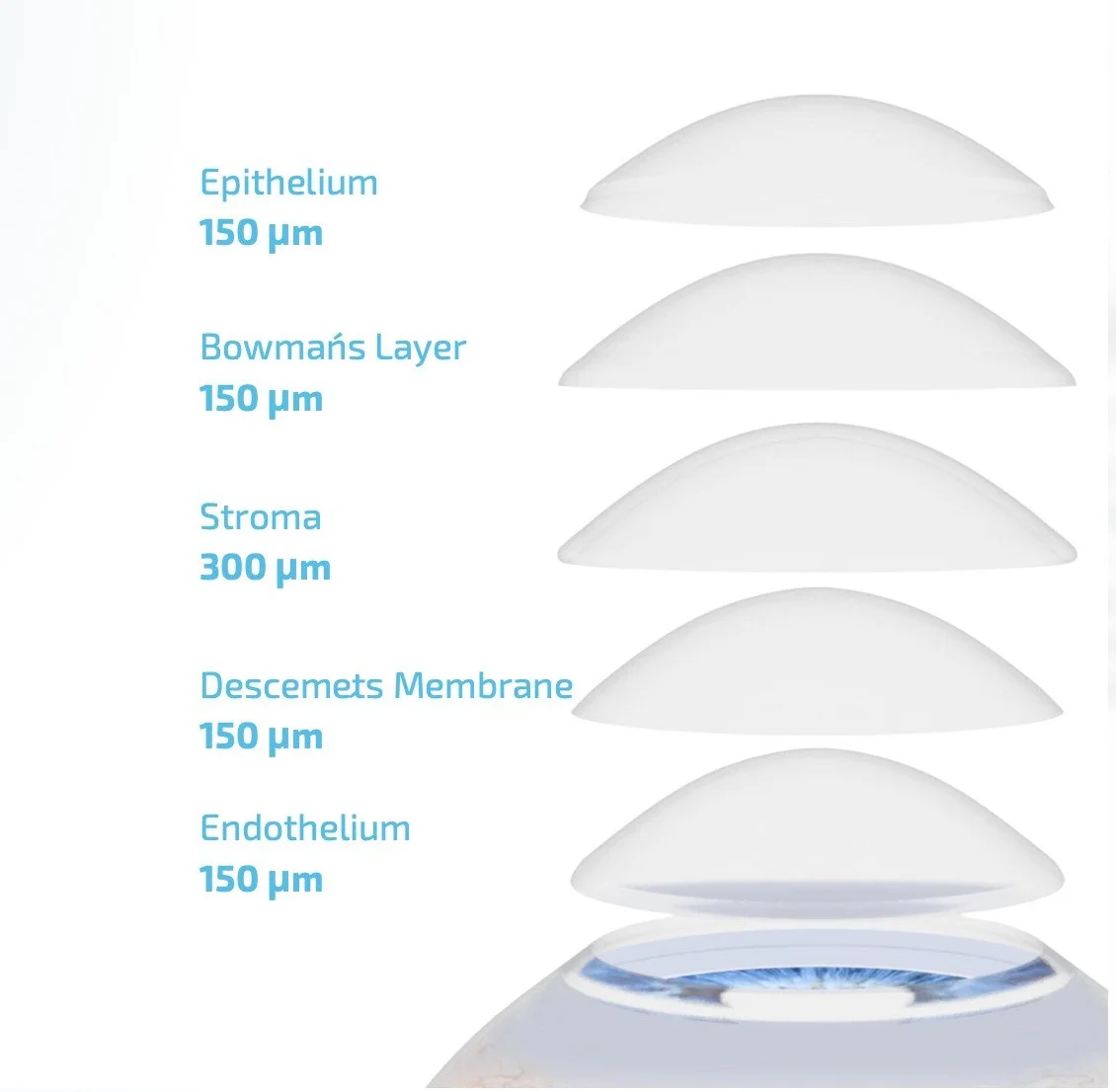
| Layer | In the human cornea | In the model | What you practise on it |
|---|---|---|---|
| Epithelium | about 50 µm, regenerates | 150 µm | The entry point of every needle. Debridement, the bite angle, and the feel of the needle passing from epithelium into stroma. |
| Bowman's layer | 8 to 12 µm, does not regenerate | 150 µm | The first resistance after the epithelium. Important for lamellar incisions and the anterior bite depth. |
| Stroma | about 450 to 500 µm, 90 percent of the cornea | 300 µm | Where every corneal suture lives. Partial-thickness bites at 80 to 90 percent depth, lamellar dissection for DALK, the trephination cut for PKP. |
| Descemet's membrane | 10 to 15 µm | 150 µm | The layer you must not perforate with a suture and must expose cleanly for DALK. Can be stripped for DSAEK and DMEK. |
| Endothelium | a single cell layer, about 5 µm | 150 µm | The inner surface. Full-thickness bites are visible from the inside, so a trainee sees immediately when a suture has gone too deep. |
Human values are typical adult figures from the anatomical literature.[4] Model values are the design thicknesses of the Eye 4 Layered Cornea.
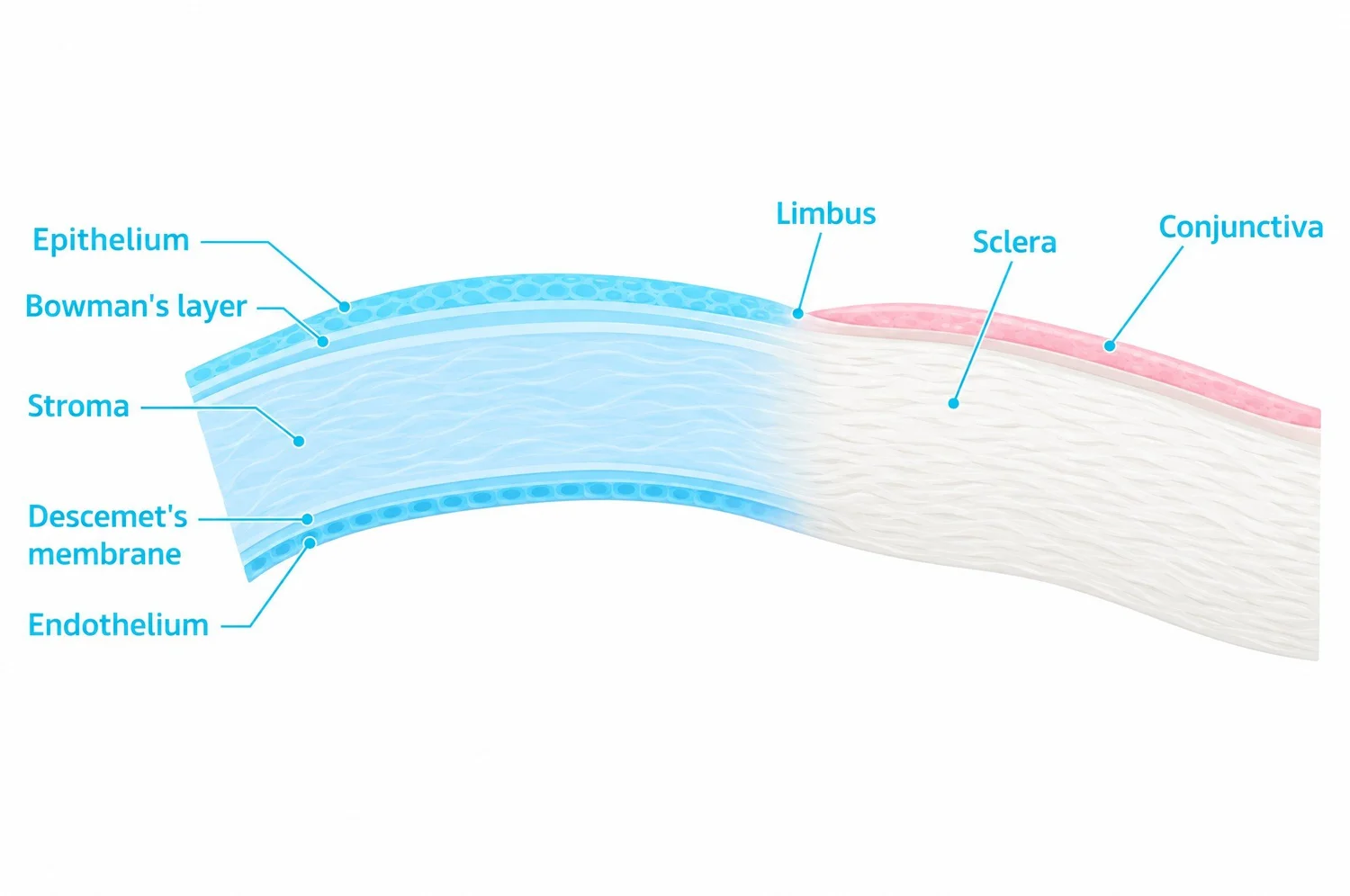
The part that matters for trauma training is the edge of this picture. In the Eye 4 Layered Cornea, the cornea is not a cap glued onto a ball. It continues into a limbus, a sclera and a conjunctiva, so a laceration can run from clear cornea across the limbus into sclera, exactly the kind of wound that a resident on call has to close.[2]
Corneal suturing practice in five exercises
This is the sequence we recommend to residents who receive their first pack. Each exercise builds one habit, and one eye is enough for the first three. Use 10/0 nylon, a micro needle holder and tying forceps under a microscope. If you have no microscope yet, a good pair of loupes works for the first two exercises.
- The single radial bite. Make a 3 mm clear corneal incision with a slit knife. Place one interrupted 10/0 nylon suture at 90 percent depth, perpendicular to the wound, with equal bites on both sides. Look at it from the side: the suture should sit in the stroma, not in the chamber. Repeat ten times along the incision, then look at the wound from the inside.Habit: depth and radiality before anything else.
- The buried knot. Tie a 3-1-1 knot, trim short, and rotate the knot into the stroma. A knot that stays on the surface irritates, erodes and loosens. On the model you can feel the moment the knot slips below the epithelium.Habit: every knot buried, every time.
- Even tension along a long wound. Extend the incision to 6 to 8 mm and close it with five interrupted sutures. Then place a drop of fluorescein-free water on the wound and press on the globe with a cannula: the wound should hold. If one suture is tighter than its neighbours you will see it in the fold it creates.Habit: tension that matches, not tension that is maximal.
- Continuous and mattress sutures. Close a second wound with a running suture, then with horizontal mattress sutures for a wound that gapes. Both are standard for corneal and corneoscleral lacerations and for scleral wounds after vitrectomy.Habit: choosing the suture pattern to fit the wound, not the other way round.
- Suture removal and wound revision. Cut a suture, remove it with forceps, and re-suture the same spot. The layered cornea shows the old track, which is what a real cornea does too.Habit: handling the wound a second time without making it worse.
Trauma: corneal, corneoscleral and scleral wounds
Open globe injuries are rare per surgeon and common per department, which is the worst combination for learning. The resident who closes a corneoscleral laceration at 2 am has often never closed one before. The layered eye lets you build that case in advance.
Because the model has a cornea, a limbus, a sclera and a conjunctiva, you can cut the wound you want to train. A short, clean corneal laceration for a first exercise. A stellate wound with three arms for a harder one. A corneoscleral laceration that crosses the limbus, which is the wound that needs the limbus closed first with 9/0 or 10/0 nylon, then the cornea, then the sclera with 8/0 under a conjunctival peritomy. And a scleral wound under the conjunctiva, where the first step is finding it.
A trauma exercise that fits in twenty minutes
Mark the limbus with a radial suture marker. Cut a 5 mm laceration that runs from clear cornea 2 mm into sclera. Close the limbus first with one 10/0 nylon. Then close the corneal part with interrupted 10/0 sutures, longer bites towards the periphery, and finally the scleral part with 8/0 or 9/0 after opening the conjunctiva over it. Finish with the conjunctiva. Then check the chamber from the inside: a well closed wound shows no gape at the endothelium.
For a complete trauma station straight out of the box, the Kit 4 Trauma Suturing bundles a suturing eye, holder, the instruments for wound closure, an intraocular magnet and viscoelastics, with or without the Head 4 Eyes. The Eye 4 Layered Cornea is the eye to add when you want the corneal layers and the corneoscleral transition.[5]
The question we get most often is whether an artificial cornea can feel like a real one. It cannot, and we say so. What it can do is show you your suture depth from the inside, hold a wound shape that a pig eye never holds, and be on the table every evening. The feel comes later, on real tissue, and faster if the habits are already there.
Keratoplasty on the model: trephination, graft and sixteen sutures
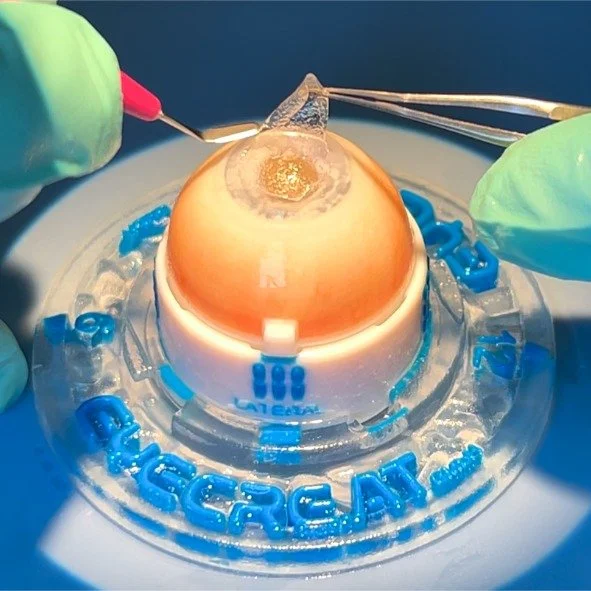
A penetrating keratoplasty is, mechanically, two circular cuts and a ring of sutures. Each step can be practised on the Eye 4 Layered Cornea with the Donor 4 Layered Cornea as graft.[3]
- Mark the centre and the diameter. Find the corneal centre, mark it, and mark the 7.5 mm trephination circle. A decentred graft is the most common and least reversible mistake.
- Trephine the recipient. A hand-held 7.5 mm trephine cuts the recipient bed: a partial-depth cut for DALK, a cut that is completed with curved corneal transplant scissors for PKP. On the layered eye you can see which layer the trephine has reached.
- Prepare the donor button. Punch the matching button from the Donor 4 Layered Cornea, usually 0.25 to 0.5 mm larger than the recipient bed, and keep it on the block until the bed is ready.
- Four cardinal sutures. Place the graft, fix it at 12, 6, 3 and 9 o'clock with 10/0 nylon, equal bites, 90 percent depth, and look for the square that the four sutures form: it tells you whether the graft is centred and the tension is even.
- Complete the ring. Add interrupted sutures to 16, or switch to a running suture after the cardinals. Bury every knot. Then check the graft-host junction from the inside.
The same eye is the recipient for DALK (big-bubble or manual dissection down to Descemet's membrane), DSAEK and DMEK (stripping of Descemet's membrane, graft insertion and positioning), so one setup covers the corneal transplantation curriculum of a fellowship.[2] Both a hand-held and a vacuum corneal trephine (7.5 mm) are available in our Instruments 4 Practice range.
What a corneal suturing station costs
One of the reasons we built the layered eye is that corneal training has been expensive to start. Clinical 10/0 nylon costs a fortune per pack, trephines are single-use in the OR, and the fellow who wants to practise keratoplasty has to beg for leftover tissue. The list below is a complete station from our store, with the prices as of October 2026, excluding VAT and shipping.[2]
| Component | Product | Price |
|---|---|---|
| Training eye | Eye 4 Layered Cornea, pack of 6 | 594.00 euros (99.00 per eye) |
| Donor tissue | Donor 4 Layered Cornea, per transplantation exercise | 19.00 euros |
| Holder | PadPro 4 Eye (rigid, for the microscope) or Set Pad 4 Eyes (silicone, set of 4) | 74.90 euros / 23.10 euros |
| Sutures | Sutures 4 Practice, 10/0 nylon for cornea, 8/0 and 7/0 for sclera and conjunctiva | per suture, see store |
| Instruments | Instruments 4 Practice: micro needle holder for 10/0, tying forceps, Colibri forceps, corneal transplant scissors, radial suture marker | per instrument, see store |
| Blades | Knives 4 Practice: slit knife 2.2 to 2.8 mm, 15 degree knife, crescent knife | per blade, see store |
| Trephine | Corneal Trephine 7.5 mm (hand-held) or Vacuum Corneal Trephine 7.5 mm, both reusable for training | 54.90 euros each |
| Complete bundle | Kit 4 Ophthalmic Suturing (Suture Skills Trainer, needle holder, tying forceps, corneal scissors, Colibri forceps) as the instrument base for the layered eye | from 262.90 euros |
The fastest way to put this together is the cornea Setup Builder: pick the eye, holder, sutures and instruments, see the total with shipping for your country, and add the whole setup to the cart in one click.
For residents and fellows: one eye instead of six. The Eye 4 Layered Cornea is sold in packs of 6 because departments order it that way. If you are a resident or fellow buying for yourself, the Setup Builder has a Residents and Fellows option that lets you order one or two eyes with the sutures and instruments you need, invoiced to you, with free shipping from 490 euros of products. Tell us your clinic and training programme and we take care of the rest.
Shipping, lead times and what to order when
We ship worldwide directly from Tyrol, Austria, without intermediaries. Eyes that are in stock reach most countries in 1 to 5 days. Larger orders and course quantities go into production first, which takes about 2 weeks, and small customer-specific adaptations of a model take 1 to 3 months to the first prototype, not counting production and shipping. If your wetlab date is fixed, write to us early and we plan the production around it.
The models are shelf-stable and need no cold chain, so a department can keep a box on the shelf and hand out an eye whenever a resident has an evening free. One eye takes about ten interrupted sutures per incision, several incisions per eye, and the corneal layers can be sutured, cut open and sutured again until the cornea is used up.
Frequently asked questions
What is the best way to practise corneal suturing?
Practise on a curved cornea with a chamber behind it, under a microscope, with the same 10/0 nylon, micro needle holder and tying forceps as in the OR. Start with single radial interrupted sutures at 90 percent depth, then buried knots, then even tension along a longer wound, then running and mattress sutures. A layered artificial eye such as the Eye 4 Layered Cornea shows suture depth from the inside and is available every evening; real tissue adds the feel later.
How many layers does the Eye 4 Layered Cornea have?
Five: epithelium, Bowman's layer, stroma, Descemet's membrane and endothelium, built as separate layers so that each can be identified, dissected and sutured. The cornea continues into limbus, sclera and conjunctiva, so corneoscleral wounds can be simulated as well.
Can I practise keratoplasty on an artificial eye?
Yes. On the Eye 4 Layered Cornea you can trephine the recipient bed, prepare a donor button from the Donor 4 Layered Cornea, place cardinal sutures and complete a 16-bite ring or a running suture for PKP. The same eye is used for DALK (lamellar dissection to Descemet's membrane), DSAEK and DMEK (Descemet stripping, graft insertion and positioning).
Can traumatic eye injuries be simulated on the model?
Yes. Because the model has a cornea, limbus, sclera and conjunctiva, you can cut corneal, corneoscleral and scleral lacerations of any shape, including stellate wounds, and close them in the clinically correct order: limbus first, then cornea, then sclera under a conjunctival peritomy, then conjunctiva.
Which sutures and instruments do I need?
10/0 nylon for the cornea, 9/0 or 8/0 for the sclera, 7/0 or 6/0 absorbable for the conjunctiva; a micro needle holder for 10/0, tying forceps, Colibri forceps, corneal transplant scissors and a radial suture marker; a slit knife and a 15 degree knife for incisions; a 7.5 mm trephine for keratoplasty. All are available as Sutures 4 Practice, Instruments 4 Practice and Knives 4 Practice.
Can I buy a single Eye 4 Layered Cornea as a resident?
Yes. The eye is sold in packs of 6 in the store, but residents and fellows can order one or two eyes through the Residents and Fellows option in the Setup Builder, together with the sutures and instruments they need. Shipping is free from 490 euros of products within the programme.
How long does delivery take?
eyecre.at ships worldwide directly from Tyrol, Austria. Eyes in stock reach most countries in 1 to 5 days. Larger orders go into production first, which takes about 2 weeks. Customer-specific adaptations take 1 to 3 months to the first prototype, not counting production and shipping.
Is the model a medical device?
No. All eyecre.at training models are NOT FOR MEDICAL OR HUMAN USE, NON-STERILE AND ONLY FOR DEMONSTRATION. They are training and demonstration products, not medical devices.
Related guides
Other wetlab guides from eyecre.at:
- Mastering the Yamane Technique: Why Practice Models Matter: scleral haptic fixation, another suture-free skill that depends on the sclera.
- Vitrectomy Wetlab Training: A Practical Guide to Practising PPV: scleral wound closure after trocar removal is the same suture as in exercise four.
- Phaco Training for Beginners: the clear corneal incision that every suturing exercise starts with.
- From Idea to Product: How We Develop Custom Training Models: if your course needs a wound, a pathology or a layer the standard eye does not have.
Sources
- American Academy of Ophthalmology, EyeWiki: "Corneal Suturing Techniques" and "Open Globe Injury" (principles of radial bites, suture depth, buried knots and the closure sequence limbus, cornea, sclera). eyewiki.org
- eyecre.at store: Eye 4 Layered Cornea, product page and price (99 euros per eye, pack of 6). www.eyecre.at/store/p/eye-4-layered-cornea
- eyecre.at: Donor 4 Layered Cornea, 19 euros per unit, one donor per transplantation exercise; included ten times in the Refill 4 Cornea Transplantation (R.S.E). www.eyecre.at/store/p/eye-4-layered-cornea
- DelMonte DW, Kim T. Anatomy and physiology of the cornea. J Cataract Refract Surg. 2011;37(3):588-598 (layer thicknesses of the adult human cornea). doi.org/10.1016/j.jcrs.2010.12.037
- eyecre.at store: Kit 4 Trauma Suturing, with Head 4 Eyes (519 euros) or without (319 euros). www.eyecre.at/store/p/kittrauma
- eyecre.at YouTube channel: Eye 4 Layered Cornea, corneal suturing demonstration, Sutures 4 Practice. www.youtube.com/@eyecreat
Build your corneal suturing station
Open the cornea Setup Builder Eye 4 Layered Cornea in the store Ask us about a course wetlabAll images and videos show artificial training models. No patient, no real tissue. The cross-section illustration is AI-generated from our own layer schematic and is labelled as such. Text prepared with AI assistance and reviewed by eyecre.at. Prices as of October 2026, excluding VAT and shipping. eyecre.at training models: NOT FOR MEDICAL OR HUMAN USE, NON-STERILE AND ONLY FOR DEMONSTRATION.