From Idea to Product: How We Develop Custom Training Models
Every surgeon learns a procedure the same way: repetition under realistic conditions, long before the first live case. But the models that make that repetition possible don't appear out of nowhere. Behind each artificial eye and wetlab kit is a development process that turns a clinical need into a manufacturable, reproducible training product.
At eyecre.at, that process is also a service. When a medtech company, a pharmaceutical partner, or a surgical education program needs a model that doesn't exist yet, we develop it — from the first prototype to serial production. Here's how custom surgical training model development actually works, step by step.
Why custom models exist in the first place
Off-the-shelf training eyes cover the most common procedures extremely well. But ophthalmology keeps moving: new techniques, new devices, new IOLs and instruments that need a safe, repeatable way to practise and to demonstrate.
That's where bespoke development comes in. A custom or white-label model lets a partner:
Train a specific technique that standard models don't reproduce (for example a new fixation method or an unusual anatomy).
Create a device-specific platform to demonstrate or validate an instrument, an injector, or an implant.
Build a branded wetlab kit for a congress, a training curriculum, or a sales team — under their own name (OEM / white-label).
The goal is always the same: an anatomically convincing model that behaves predictably, every single time.
Our 5-step development process
1. Discovery & requirements
Every project starts with the clinical goal, not the geometry. What technique or device does the model need to support? Which tissues and structures matter for realism, and which can be simplified? What are the constraints on volume, budget, and timeline?
We define the anatomy that needs to be reproduced, the handling characteristics that matter (how a needle passes, how tissue resists, how a capsule tears), and the success criteria the finished model has to meet.
2. Design & CAD
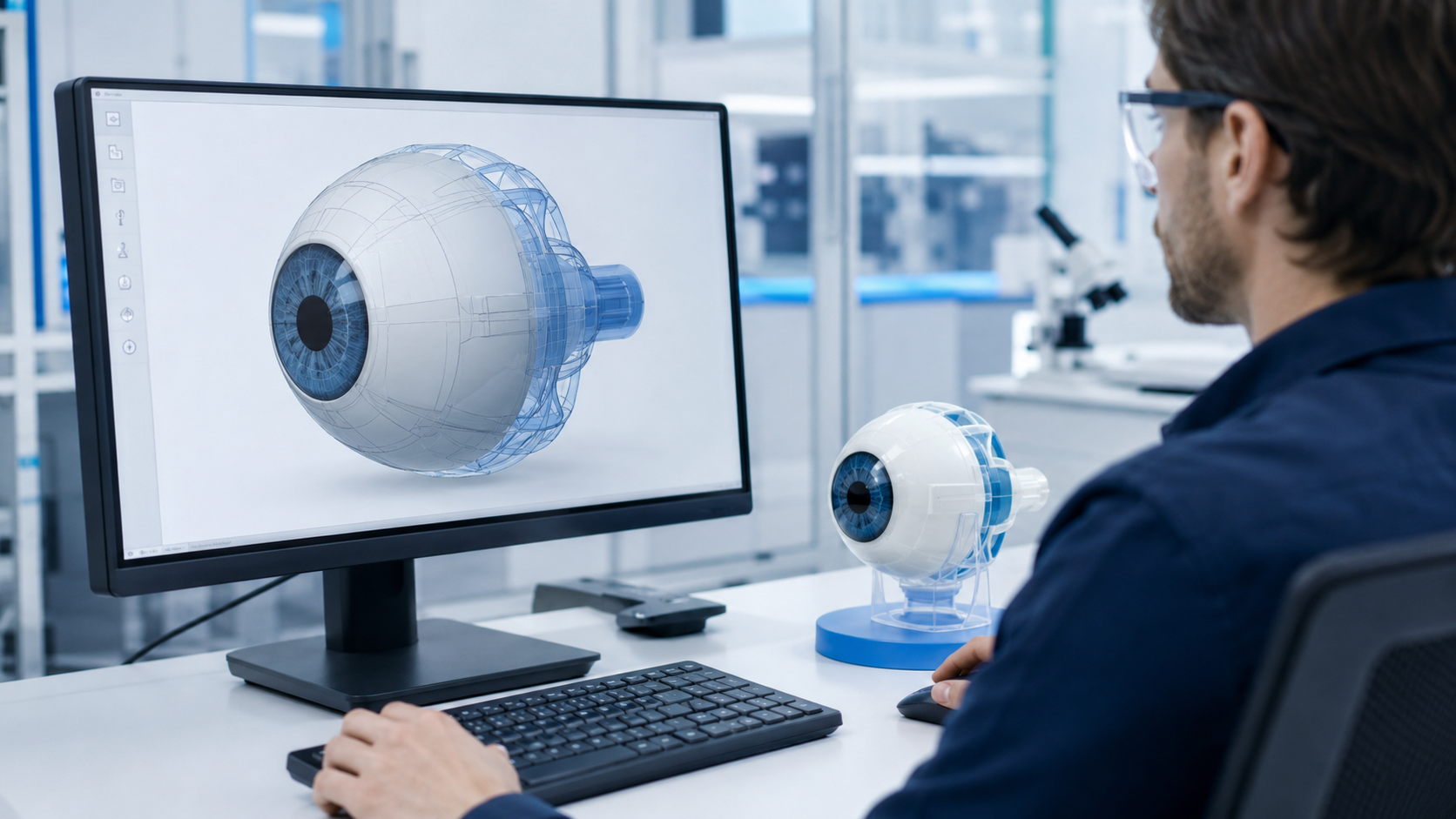
Next, the requirements become a 3D model. Working in CAD, we design the eye and its components around the relevant anatomy and the way it has to perform on the bench — wall thickness, internal structures, mounting, and the interface with the wetlab pad or holder.
This is where realism and manufacturability are balanced: a model that looks perfect but can't be produced consistently isn't a product.
3. Prototyping
The design is then 3D-printed as a physical prototype. Using advanced PolyJet technology, we can combine multiple materials and hardness levels in a single part — essential for reproducing the different layers and tissues of the eye.
Prototypes are tested, evaluated, and refined in iterations. Layers are tuned, structures adjusted, and handling validated against the success criteria from step 1. This loop is the heart of development — and it's where most of the realism is won.
4. Validation
Once a prototype performs as intended, it's validated against real-world use. Does the technique work on the model the way it works in surgery? Is the behaviour consistent from unit to unit? Does it hold up to the demands of a busy wetlab or a congress station?
For partner projects, this is also where clinical feedback is gathered, so the final model reflects how surgeons will actually use it.
5. Serial production
When the design is locked, we move to serial production. Manufactured in Austria, every unit is produced to the same specification, so the hundredth model behaves like the first. From here, the product can ship as a standalone model, as part of a set or kit, or as a branded, white-label solution under the partner's own name.
Who this is for
Custom development is built around four kinds of partners:
MedTech companies developing or demonstrating a device that needs a dedicated training or validation platform.
Pharmaceutical partners — for example anti-VEGF programs — that need branded, procedure-specific kits for education and events.
Congress organisers and training programs that need a reproducible model for hands-on courses at scale.
Product developers who need an OEM / white-label model produced to their specification.
See the process in action
Prototyping is where the development story becomes tangible. The short clip below shows how we build up the different skin and tissue layers of a model during prototyping — the same iterative approach behind every custom project.
Start your project
If you have a technique to train, a device to demonstrate, or a model that doesn't exist yet, we can develop it with you — from first prototype to serial production, made in Austria.
To explore what's already possible, browse the product range or ask the AI Configurator which models fit your procedure. To start a custom development project, get in touch at request@eyecre.at and tell us what you're trying to achieve.
We change the world eye per eye at a time. — David Ortner