

How to choose a cataract surgery training model
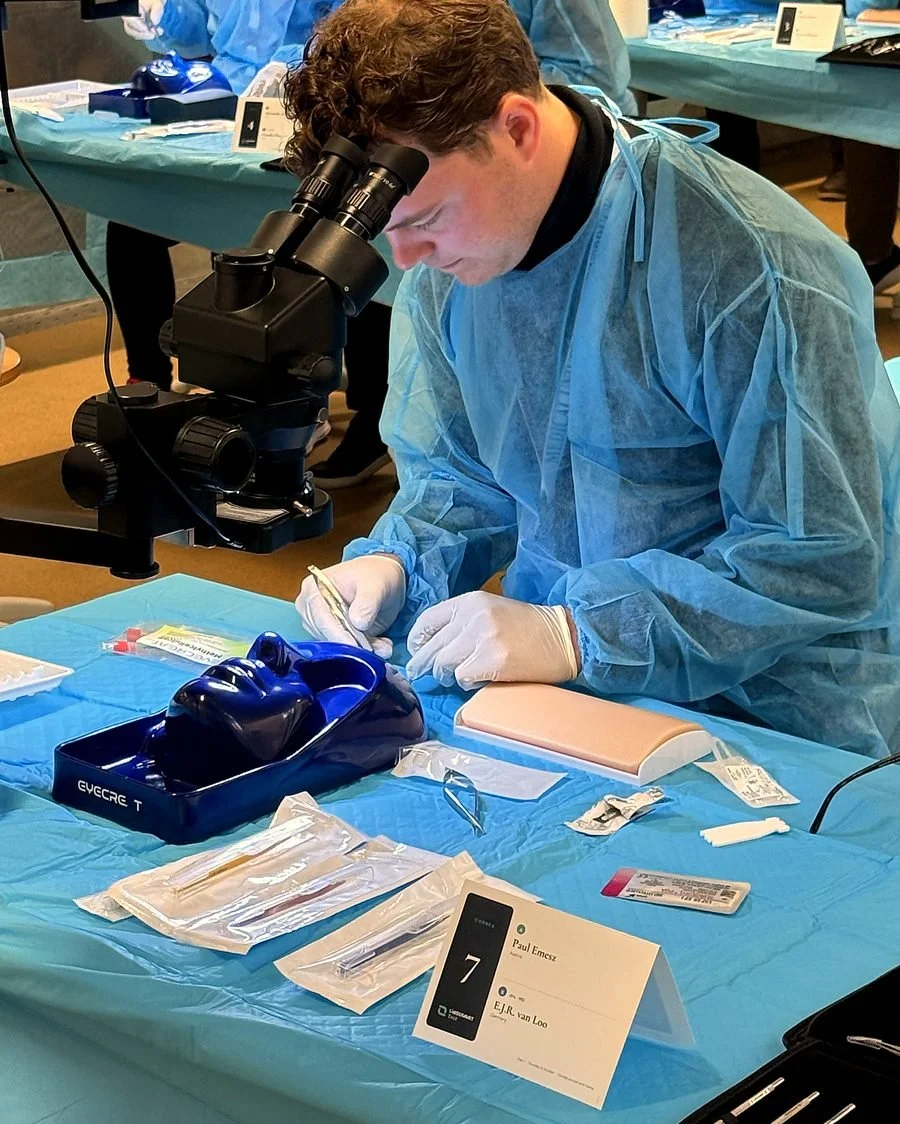
Short answer: for capsulorhexis, phacoemulsification and IOL implantation, an artificial eye with a human-equivalent capsular bag is the most useful wetlab model, because porcine capsules behave differently from human ones and VR simulators cannot train instrument feel. For basic incision and suturing practice, porcine eyes remain the cheapest option. For structured assessment with automatic scoring, a VR simulator is unmatched, at a very different budget. Most established training programmes use two of the three.
There is no single best cataract training model. There is a best model for a given skill, budget and setting. This guide compares the four options actually in use in ophthalmology residency programmes, congress wetlabs and home practice, and says where each one falls short, including ours.
The four options, compared
| Criterion | Porcine eyes | Artificial eyes | VR simulator | Dry lab |
|---|---|---|---|---|
| Cost per session | Very low per eye; cold chain, disposal and lab fees on top | €45 to €99 per eye, nothing beyond a microscope | No per-session cost; device is a capital purchase plus service contract | Very low |
| Anatomical fidelity (cataract) | Lens and capsule behave differently from the human eye | Human dimensions; graded nucleus densities, defined pupil sizes | High visual fidelity, no physical tissue | None |
| Tactile feedback | Real tissue, but not human-equivalent for the capsule | Real instruments, tissue-like materials | Haptic approximation or none | Physical, not tissue-like |
| Reproducibility | Varies from eye to eye | Identical eyes, defined difficulty level | Fully standardised | High |
| Pathology on demand | No | Yes: compromised capsule, small pupil, hard nucleus | Yes, in software | No |
| Infrastructure needed | Cold storage, biological waste handling, permission for animal tissue | Microscope, holder, instruments | Dedicated room, power, maintenance | A table |
| Objective scoring | No | No (instructor-based) | Yes, automatic | No |
| Best at | Incisions, suturing, low-cost volume practice | Capsulorhexis, phaco, IOL, complication management | Curriculum tracking, assessment, early orientation | Hand positioning, microscope ergonomics |
What each option is really good at (and where it is not)
Porcine eyes
The oldest wetlab model and still a good one for incisions and suturing, because the cornea and sclera give real tissue resistance for a very low price. The problem for cataract training is the lens: the porcine capsule is thicker and more elastic than the human capsule, and the nucleus is soft, so a capsulorhexis that works on a pig eye does not teach the tear behaviour a surgeon meets in the OR. Porcine eyes also need a cold chain, ethics-compliant disposal and a lab that is allowed to handle biological material, which rules them out for home practice and for many congress venues. Our real tissue guide covers the logistics.
Artificial eyes
Synthetic or 3D-printed eyes built to human dimensions, with a capsular bag that tears and a nucleus that can be fragmented. Their advantage is reproducibility: every eye in a pack behaves the same, difficulty can be chosen (nucleus density, pupil size, compromised capsule), and there is no biological infrastructure at all. Their disadvantage is simple: at €45 to €99 per eye they cost more per unit than animal tissue, and no synthetic material matches every property of real tissue at once. For scleral work and fine corneal suturing, porcine tissue still feels closer to the real thing.
VR simulators
Devices such as Eyesi (Haag-Streit) and the HelpMeSee simulator give standardised scenarios, automatic scoring and unlimited repetitions, which makes them the strongest tool for curriculum tracking and assessment. They do not train instrument handling with real instruments, real viscoelastic or a real microscope, and the purchase price puts them out of reach for most individual residents and many departments. Programmes that own one typically still run a physical wetlab alongside it.
Dry labs
Suturing pads, foam and non-anatomical practice stations. Useful in the first weeks for hand positioning and microscope ergonomics, and essentially free. They do not train any step of cataract surgery itself.
What the evidence says. A 2025 systematic review and meta-analysis in Eye covering 25 studies and 17,623 eyes found that simulation-based training reduced posterior capsule rupture in resident cohorts with an odds ratio of 0.71 (95 % CI 0.60 to 0.85), with positive training effects in 22 of 25 studies (88 %) (source). A 2020 review in the same journal counted 93 simulators across 131 studies: 47 wetlab models, 26 dry-lab tools and 53 VR systems (source). The evidence supports simulation training as such. It does not crown one model type, which is why the choice below is about the skill you want to train.
Which model for which skill
| Skill | Recommended model | Why |
|---|---|---|
| Corneal and scleral incisions | Porcine eye or artificial eye | Both work; porcine is cheaper for volume |
| Continuous curvilinear capsulorhexis | Artificial eye with human-equivalent capsule | Porcine capsule tears differently |
| Hydrodissection and phaco (chop, divide and conquer) | Artificial eye with graded nucleus | Choose soft, medium or hard nucleus deliberately |
| IOL implantation and centration | Artificial eye | Consistent capsular bag size |
| Complication management (small pupil, weak zonules, capsule rupture) | Artificial eye with defined pathology | Cannot be produced on demand in animal tissue |
| Suturing (corneal, scleral) | Porcine eye or dedicated suturing model | Tissue feel matters most here |
| Assessment and curriculum tracking | VR simulator | Objective scoring |
eyecre.at models for cataract training
We make artificial eyes, so this is the part of the guide that is about our own products.
Eye 4 Cataract
€45 to €99 per eye, packs of 6 or 12. Three nucleus densities (soft, medium, hard), 7 mm standard or 4 mm small pupil. For rhexis, phaco and IOL.
Eye 4 Compromised Capsule Bag
For complication management: a defined capsular defect, reproducible in every eye.
Eye 4 Open Sky
Reusable, for IOL handling and positioning without the rhexis step.
Solo starter setup
From €614.90: eye holder, practice instruments, consumables and eyes for one resident. Details in the cataract training hub.
All eyecre.at prices are public, see the full pricing overview. No quote is required for standard products. Prices exclude VAT.
Go to the cataract training hub
Frequently asked questions
What is the best model for practising capsulorhexis?
An artificial eye with a human-equivalent capsular bag. The porcine capsule is thicker and more elastic than the human one, so it does not reproduce the tear behaviour that makes the rhexis difficult in real surgery.
Are artificial eyes better than pig eyes for cataract training?
For the lens-related steps (rhexis, phaco, IOL), yes, because of capsule behaviour, graded difficulty and consistency. For incisions and suturing, pig eyes are a cheaper and perfectly good option. Many wetlabs use both.
Do I need a VR simulator for a residency programme?
Not to teach the skills. A VR simulator adds objective assessment and curriculum tracking, which is valuable for programmes that must document competency. Physical wetlab models remain necessary for instrument handling.
How many eyes does a resident need?
In the early phase, residents typically perform ten or more rhexis runs per week, so a pack of 12 eyes covers roughly one month of structured practice.
Can I practise cataract surgery at home?
Yes, with an artificial eye, a holder and a desk microscope or loupe setup. Animal eyes are not suitable for home use because of cold-chain and disposal requirements. See our wetlab setup guide.
Last updated: September 2026 · Training models are NOT for medical or human use, non-sterile, for demonstration and practice only.