Phaco Training for Beginners: eyecre.at vs. BIONIKO vs. SimulEYE vs. Kitaro
Choosing practice eyes for a resident's first phacoemulsification steps? Here is how the four systems you are probably comparing actually differ, including where our competitors are ahead.
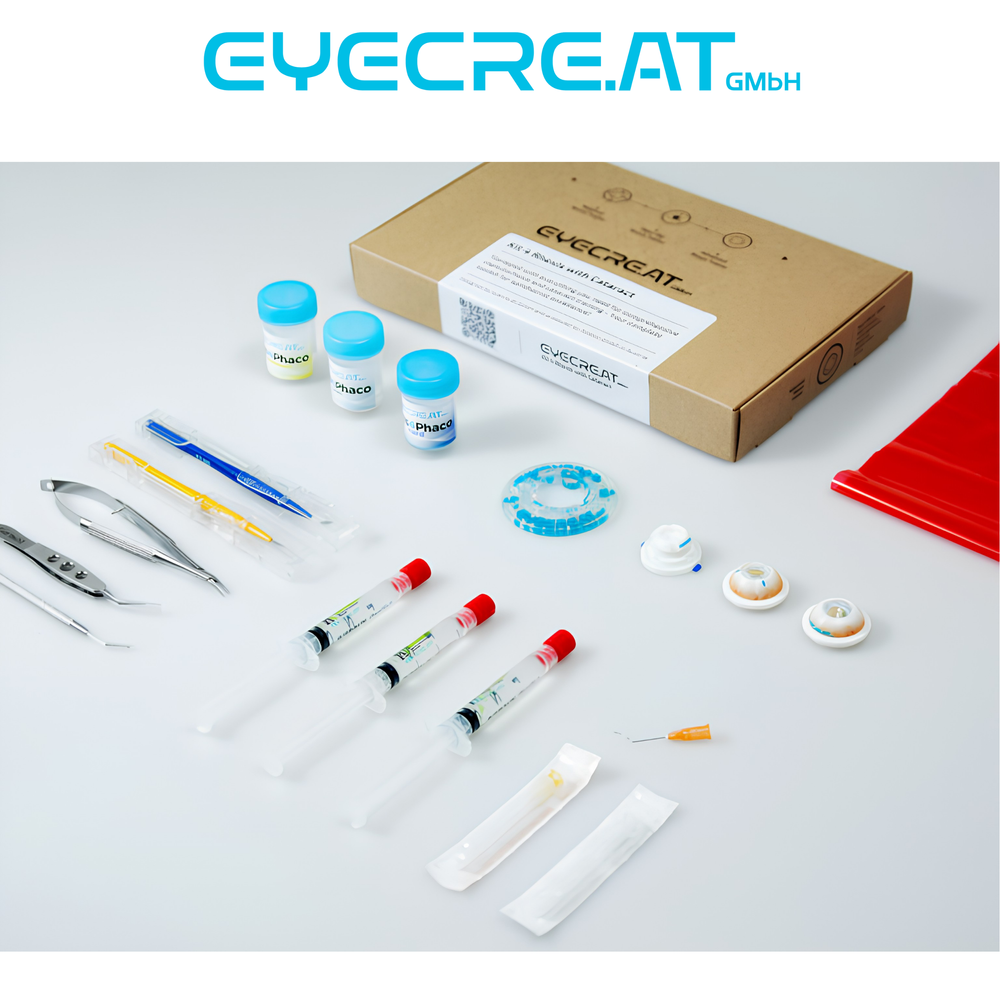
For first phaco steps, all four systems work, and each has a distinct sweet spot. Kitaro offers the most established step-by-step curriculum on an enlarged eye. BIONIKO offers a clever modular platform with a validated capsulorhexis approach. SimulEYE offers strong US-based kits with published pricing. eyecre.at offers realistic artificial eyes with soft, medium and hard nuclei, transparent euro pricing, EU shipping, and about €10 per complete phaco training run with the €299 Kit 4 Rhexis core kit. If you are a European program equipping a beginner wetlab, we think our case is strong. But we make one of the four, so read on and judge for yourself.
Why we wrote this comparison
If you are setting up phaco training for residents, you are probably comparing these four names anyway. We would rather put the facts side by side ourselves, including the points where our competitors are ahead, than let you piece them together from four websites and a quote request. Objective criteria, dated facts, and open acknowledgment of what the others do well.
What a phaco beginner actually needs
Most curricula break the first months down into: instrument handling under the microscope, corneal incisions, the continuous curvilinear capsulorhexis (the step with the steepest learning curve), hydrodissection, nucleus disassembly (divide and conquer first, chopping later), irrigation and aspiration, and IOL implantation. A good beginner setup therefore needs three things: very high repetition at low cost per attempt, a realistic anterior chamber that punishes the same mistakes a real eye would, and a progression path from soft to hard nuclei once the basics sit.
The question is not "which model is best" and not even "what does the kit cost." The metric that matters is cost per training run: what one full repetition (one capsulorhexis, one nucleus) costs once the box is on your bench.
The four systems at a glance
| eyecre.at | BIONIKO | SimulEYE | Kitaro (Frontier Vision / FCI) | |
|---|---|---|---|---|
| Based in | Austria (EU) | Miami, USA | California, USA | Japan; distributed by FCI |
| Pricing | Public EUR prices on every product | Public USD prices in webshop | Public USD prices (marked "U.S.A. only") | On request via distributors |
| Buy online | Yes | Yes | Yes | No, quote-based |
| Capsulorhexis for beginners | Kit 4 Rhexis with Cataract (from €299): reusable trainer platform, rhexis foils for hundreds of repetitions; Eye 4 Open Sky (€450 for 6) | Rhexis practice on OKULO models; OKULO BR8 ($84.75, aphakic) plus cataract lenses ($113 for 6) and AVH holder ($113) | SimuloRhexis 2.0 (from $40; kit $295; rhexis films $80) | Anterior capsule films and precut sclerocorneal sheets in the DryLab |
| Phaco with a real phaco machine | Eye 4 Cataract (€540 for 12) with soft, medium and hard nuclei | Cataract lens modules on OKULO platform | PhacoMaster (from $70; kit from $395; lenses $100) | WetLab with soft, medium-hard and hard artificial nuclei |
| Nucleus disassembly techniques | Divide and conquer, stop and chop, chop across three hardness levels | Medium (G II-III) and hard (G III-IV) cataract lenses | Phaco lenses plus dedicated Pre-Chop lenses (from $62.50) | Dedicated nuclei for divide and conquer, stop and chop and phaco chop |
| Cost per phaco training run | About €10 per nucleus at the €299 core-kit price (30 lenses included); refills €189 (Small) / €229 (Big); Eye 4 Cataract €45 per single-use eye | Reusable base plus consumable lenses, about $19 per lens ($113 for 6) | Refill lenses and films at published prices ($100 lenses, $80 films) | Not calculable from public data (quote-based) |
| Complete standalone set (incl. head/holder) | Kit 4 Rhexis with Cataract "With Head 4 Eyes" (€499, incl. Head 4 Eyes and PadPro 4 Eye) | Cataract Starter Kit ($644.10); AVH holder $113 separately | PhacoMaster Kit from $395; PhacoMaster Station $425 | Combo kit is standalone by design (face, stands, dry and wet lab), quote-based |
| Anatomy scale | Anatomically realistic artificial eyes | Compact modular models on holders | Model eyes in mounts/stations | Enlarged eye (about 1.5x) in a face with nose |
| Progression path | Soft to hard nuclei; small pupil (4 mm) variant; complication models (compromised capsule bag) | Starter kits (Cataract Starter Kit $644.10); complication and MSICS models | Kits from rhexis to phaco to anterior segment modular kit ($495) | Integrated dry-to-wet curriculum in one combo kit |
| Shipping to Europe | From within the EU, no customs paperwork | From the US | From the US (published prices exclude duties) | Via regional FCI distributors |
| Real-tissue (pig eye) support | Dedicated holders, pads and pins | Not offered | Not offered | Not offered |
| Custom / OEM work | Core business | Not advertised | Industry partnerships | Not advertised |
All information based on the manufacturers' public websites, August 2026. List prices excluding shipping and taxes. Spotted something outdated? Tell us and we will fix it.
Cost per training run, not cost per kit
Kit prices are what websites show; training runs are what residents consume. The programs that produce confident phaco surgeons schedule dozens of repetitions per trainee, and at that volume the per-repetition price dominates everything else in the budget. One warning before the numbers: compare configurations, not headline prices. Every system here is sold in layers, so a fair comparison lines up three levels separately.
Level 1: the complete standalone setup (nothing else needed). With eyecre.at, that is Kit 4 Rhexis with Cataract in the "With Head 4 Eyes" configuration (€499): it includes the Head 4 Eyes holder and the PadPro 4 Eye, so an empty bench becomes a working rhexis and phaco station out of one box. BIONIKO's equivalent is the Cataract Starter Kit ($644.10). SimulEYE's kits start at $395, with a dedicated PhacoMaster Station at $425. Kitaro's Combo kit is inherently standalone (face, stands, dry and wet lab in one), priced on request.
Level 2: the core kit, if your bench already has a head or holder. With eyecre.at, the same kit "Without Head 4 Eyes" (€299) delivers the full training content without duplicating hardware you own. BIONIKO's equivalent: OKULO BR8 at $84.75 plus cataract lenses, with the AVH holder ($113) only if you lack one. SimulEYE sells single models from $40 (rhexis) and $70 (phaco) for existing mounts.
Level 3: refills, which is where cost per run is really decided. Our kit ships with 10 soft, 10 medium and 10 hard Lens 4 Phaco nuclei: 30 complete phaco runs across the full hardness progression, about €10 per run at the €299 core-kit price. After that, a Small Refill (€189) covers occasional practice and a Big Refill (€229) covers courses and high-frequency programs. BIONIKO prices refills honestly too: about $19 per nucleus ($113 for 6). SimulEYE publishes refill prices ($100 phaco lenses, $80 rhexis films); per-run cost depends on pack sizes. Kitaro's per-run cost cannot be calculated from public data; ask the distributor for the consumables price list, not just the kit price, because that is where the real number lives.
What one complete phaco training run costs with eyecre.at
Calculated from list prices, August 2026. Two ways to train, one budget question.
Both are valid: the kit maximizes repetitions per euro for skill building; the single-use eye gives every session a completely fresh anterior segment. Many programs combine them. Competitor refills are priced in USD and pack sizes vary, so we chart only our own numbers here; the table above lists theirs.
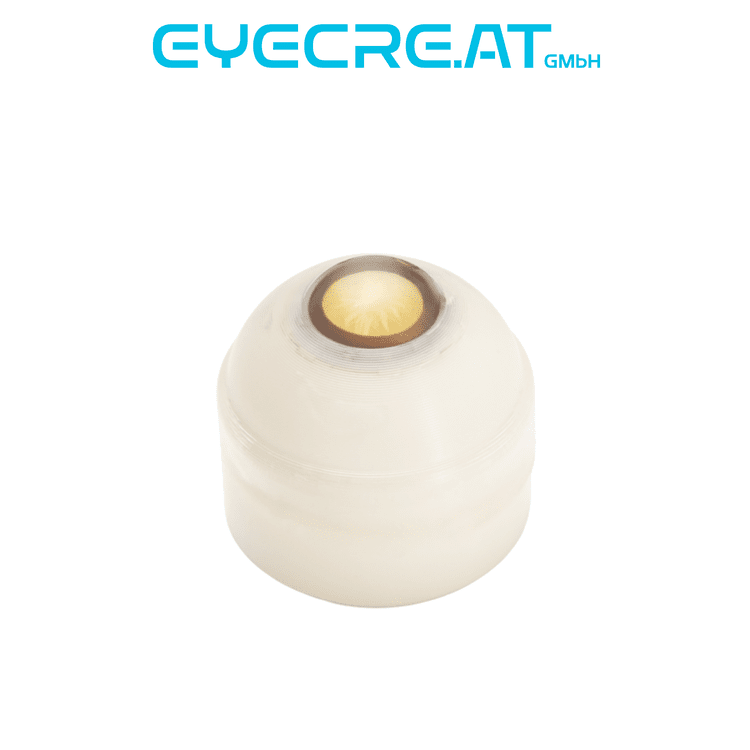
For programs that prefer a complete disposable eye per trainee and session instead of a platform-plus-refill model, Eye 4 Cataract is the alternative: €45 per single-use eye in the 12-pack, with the whole anterior segment fresh every time. Whichever supplier you choose: budget in training runs, not in kits, and make sure every quote you compare sits on the same level.
Where the others are genuinely strong
An honest comparison names the competition's strengths, so here they are.
Kitaro: the most established beginner curriculum
The Kitaro kits from Frontier Vision (Japan) are a fixture in residency programs worldwide and appear in published simulator studies. The combo kit walks a trainee from dry-lab instrument handling to wet-lab phaco on one platform, with a face and nose for realistic surgical access and dedicated nuclei for divide and conquer, stop and chop and phaco chop. The enlarged eye (about 1.5x) is forgiving in the very first sessions: easier to see, easier to hit.
Trade-offs: pricing only on request through distributors, and every trainee eventually has to translate the enlarged geometry back to a real-size eye.
BIONIKO: the affordable modular rhexis pioneer
Their capsulorhexis approach was presented at ARVO, and the modular OKULO system is well thought out: a reusable base model ($84.75), consumable cataract lenses, one holder for many procedures. Entry cost per model is low, and their models are a common sight at AAO and ASCRS wetlabs.
Trade-offs: a working beginner setup needs base plus holder plus lenses, and European orders ship from the US.
SimulEYE: strong kits, published prices
The PhacoMaster line covers rhexis films, phaco lenses, pre-chop lenses and a dedicated station, backed by named surgeon testimonials and their own course program (SimulEYE University). As of August 2026 they publish US pricing on their site, which we consider a win for the whole field.
Trade-offs for Europeans: prices are marked "U.S.A. only," and shipping crosses customs.
Where eyecre.at fits for a phaco beginner
Repetition is the whole game, so we price for it. Capsulorhexis and basic phaco are volume skills, which is why our beginner offer is built around cost per training run rather than cost per box. Kit 4 Rhexis with Cataract ships with 30 nuclei on a reusable three-stage trainer platform: about €10 per complete phaco run at the €299 core-kit price, plus hundreds of capsulorhexis repetitions on the included foils. Consumables stay cheap on purpose: Lens 4 Phaco refills at €60, capsule dye at €3.30, OVD substitutes at €9.50.
Realistic scale from day one. Our eyes are built to realistic anatomy, so the movements a trainee grooves are the movements they will use in theatre. We think the enlarged-eye approach is a legitimate teaching philosophy; ours is that the transfer gap should be as small as possible from the first rhexis on.
A progression path that includes complications. The progression starts inside the kit: the same base assembles into a Beginner, an Open Sky and an Advanced rhexis trainer, so difficulty rises without buying new hardware. When the basics sit, the platform continues: a small-pupil (4 mm) variant of Eye 4 Cataract, a compromised capsule bag model for PCR management, and IOL implantation models (Eye 4 IOL, €594 for 6) that need no phaco at all.

European logistics. Made in Austria, shipped from the EU: no customs broker, no import paperwork, fast replacements when the wetlab course is next week. Every price is public in euros, so you can budget a full beginner setup without a single sales call.
And where we are honest about limits: we do not offer an integrated face/nose platform like Kitaro's, we do not run our own course program like SimulEYE University, and if your curriculum calls for real tissue first, we will tell you so and sell you the pig-eye holders instead. Artificial where it is better, real tissue where it is better.
Which system for which beginner?
Choose Kitaro if
you want one integrated dry-to-wet curriculum on an enlarged eye and your procurement process is fine with quote-based pricing through a distributor.
Choose BIONIKO if
you want the lowest entry price per model and a modular system you can extend piece by piece, and US shipping is not an issue.
Choose SimulEYE if
you are in North America, want kits with a strong testimonial base, or want to combine models with their US course program.
Choose eyecre.at if
you are in Europe, want realistic-scale eyes with a soft-to-hard nucleus progression at about €10 per training run, want to see every price before talking to anyone, or want one supplier for artificial models, complication training and real-tissue wetlab equipment.
FAQ
What is the best phaco training model for beginners?
There is no single best model. Kitaro offers the most established integrated curriculum, BIONIKO the cheapest modular entry, SimulEYE strong US-based kits, and eyecre.at realistic-scale eyes with transparent EU pricing and a soft-to-hard nucleus progression. For European residency programs, eyecre.at and Kitaro are the two we see compared most often; the practical differences are pricing transparency, anatomy scale and shipping.
What does one phaco training run actually cost?
Calculated from published prices in August 2026: about €10 per run with the eyecre.at Kit 4 Rhexis with Cataract (€299 core kit with 30 included nuclei; €499 as a complete standalone set including the Head 4 Eyes holder), €45 per run with a single-use Eye 4 Cataract, and about $19 per consumable lens on a BIONIKO OKULO base. SimulEYE's per-run cost depends on refill pack sizes ($100 phaco lenses, $80 rhexis films), and Kitaro's cannot be derived from public data. Capsulorhexis-only repetitions are far cheaper on every foil-based system.
Can I practice capsulorhexis without a phaco machine?
Yes. Capsulorhexis is a purely manual step, and every system here offers a dry option: Kitaro's DryLab films, SimulEYE's SimuloRhexis, BIONIKO's rhexis models, and our Kit 4 Rhexis and Eye 4 Open Sky. A microscope (or a smartphone setup in a pinch) and forceps are enough for hundreds of repetitions.
How much does a beginner phaco setup cost?
As of August 2026, and depending on whether you already own a head or holder: the eyecre.at Kit 4 Rhexis with Cataract costs €299 as a core kit and €499 as a complete standalone set including the Head 4 Eyes holder and PadPro 4 Eye; refills cost €189 (Small) or €229 (Big). A 12-pack of single-use Eye 4 Cataract is €540. BIONIKO's Cataract Starter Kit lists at $644.10. SimulEYE kits run from $295 to $495, US prices only. Kitaro pricing is available on request from FCI distributors. Whichever you compare, make sure the quotes sit on the same configuration level.
Do artificial eyes work with any phaco machine?
The wet-lab models compared here are designed for use with standard phacoemulsification handpieces and machines; you use your department's own phaco unit. Check each manufacturer's instructions for fluidics settings and compatible tip sizes.
Are artificial eyes better than pig eyes for learning phaco?
Each has strengths: artificial eyes are standardized, always available and need no biosafety setup; porcine eyes offer real tissue feel but vary and require preparation and disposal logistics. Many programs combine both. We are the only supplier in this comparison that equips both approaches, and we will tell you honestly when a pig eye is the better tool for a given step.
Try it against your own curriculum
Kit 4 Rhexis with Cataract Shop cataract training eyes Talk to usThis comparison references KITARO® (Frontier Vision Co., Ltd. / FCI), BIONIKO® and SimulEYE® as third-party trademarks solely for factual comparison. All data from public sources, August 2026. eyecre.at training models: NOT FOR MEDICAL OR HUMAN USE, NON-STERILE AND ONLY FOR DEMONSTRATION.