Mastering the Yamane Technique: Why Practice Models Matter
What Is the Yamane Technique?
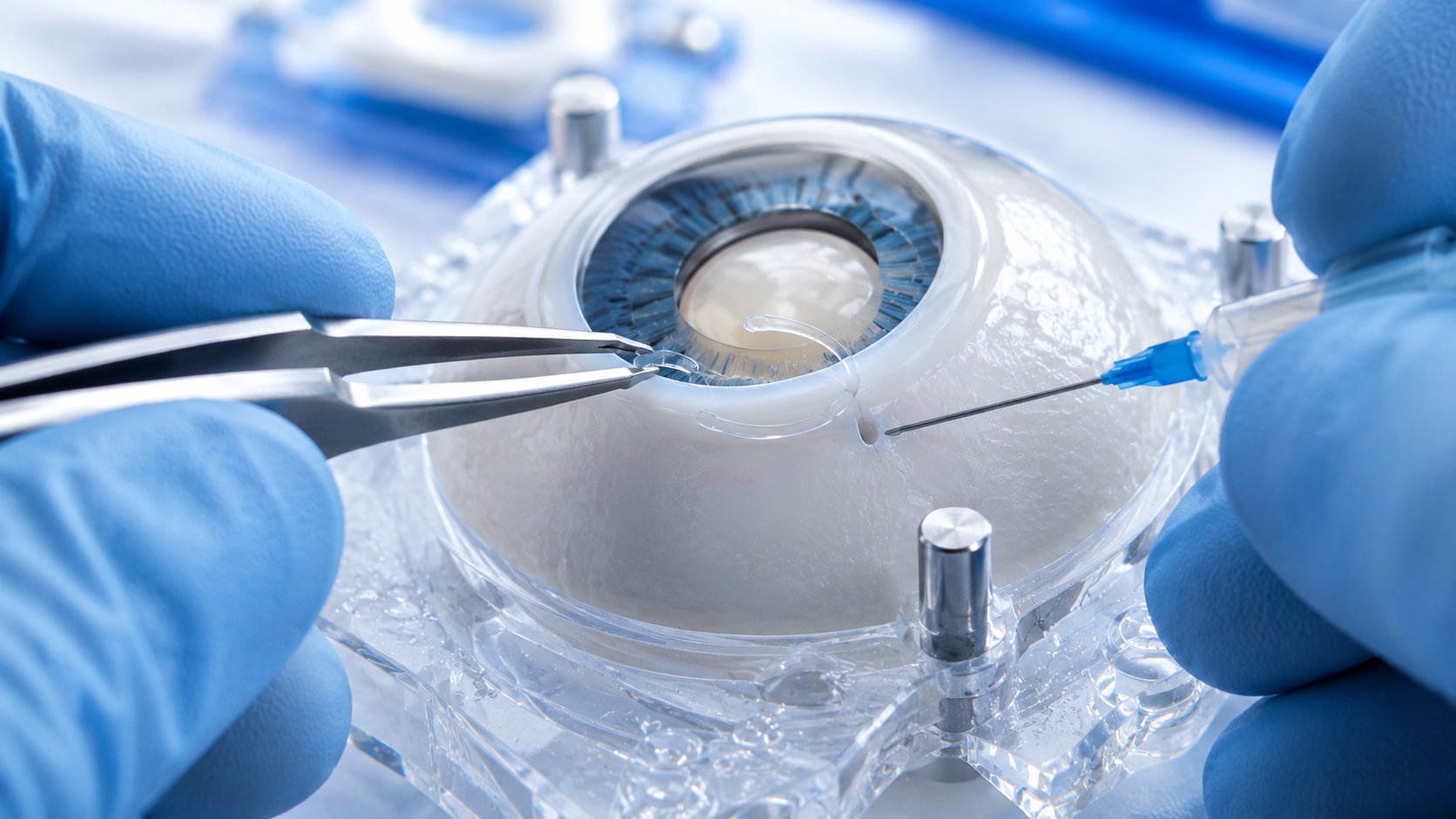
The Yamane technique is a sutureless, flanged intrascleral haptic fixation method for implanting a posterior chamber IOL when the lens capsule cannot support one. Both haptics of a three-piece IOL are externalised through angled scleral tunnels, and their tips are softened with low-temperature cautery to form small "flanges" that are then tucked back into the sclera to anchor the lens.
Its appeal is clear: no sutures to erode or break, a relatively stable long-term fixation, and a comparatively small number of steps. But each of those steps demands precision — and several of them are difficult to learn safely on live patients.
Why the Learning Curve Is So Steep
A few specific moments in the Yamane procedure are notoriously hard to master:
Symmetric needle docking. The two 30-gauge needle passes must be positioned symmetrically, or the IOL ends up tilted or decentred. Getting both angles and entry points consistent takes repetition.
Haptic threading. Feeding a fine, springy haptic into the lumen of a thin-walled needle is a delicate manoeuvre that is easy to fumble — and dropping a haptic mid-procedure is stressful in a live case.
Flange creation. The cautery step requires the right amount of heat to form a flange of the correct size. Too little and it won't anchor; too much and the flange is malformed.
Avoiding haptic damage. Excessive handling or kinking weakens the haptic, risking late dislocation.
None of these are concepts you can fully learn from a textbook or a video. They are tactile, hand-skill problems — and tactile problems are solved through deliberate, repeated practice.
Why Practice Models Matter
This is the core argument for practising the Yamane technique on a realistic model before performing it in the operating room. A good practice model lets a surgeon:
Repeat the hardest steps — needle docking, haptic threading, flanging — as many times as needed, without time pressure or patient risk.
Fail safely. Dropping a haptic or malforming a flange on a model is a learning moment, not a complication.
Build genuine muscle memory for the angles and forces involved, so that the movements become reliable rather than tentative.
Shorten the live learning curve, arriving at the first real case with the mechanics already familiar.
Deliberate practice — repeating a difficult skill in a controlled setting with the freedom to make and correct mistakes — is how complex motor skills are built in every demanding field. Surgery is no exception.
Practising Yamane in the Wetlab
A wetlab setting is the natural home for this kind of practice. With a realistic artificial eye that reproduces the relevant anatomy — a stable sclera to tunnel through, a working anterior segment, and the space to manoeuvre an IOL — surgeons can rehearse the full sequence end to end, or drill individual steps in isolation.
This is exactly what we built the Eye 4 Yamane for. It is a dedicated artificial eye simulator, purpose-made for the Yamane technique, with the realistic anatomy and consistent tissue response needed to practise the steps that matter most:
Yamane sutureless IOL fixation, start to finish
30-gauge needle intrascleral haptic tunnelling
IOL haptic flanging and positioning
Posterior chamber IOL fixation without sutures
Repeat practice to build speed and consistency
Like all our models, the Eye 4 Yamane is made in Austria, and it pairs with accessories such as the PadPro 4 Eye and Angle Retainer 4 Eye for a complete wetlab setup. Realistic, repeatable practice is the entire reason it exists: to let experienced surgeons develop confidence with a demanding technique before it counts.
Conclusion
The Yamane technique offers real advantages for secondary IOL fixation — but those advantages are only accessible to surgeons who have put in the practice to perform it reliably. A steep learning curve is not a reason to avoid a valuable technique; it is a reason to practise it properly first. Realistic training models turn that steep curve into a manageable one.
Ready to practise the Yamane technique? Explore the Eye 4 Yamane in our store, or get in touch — we're happy to help you find the right setup for your wetlab.