Conjunctival suturing is the last step of almost every glaucoma operation, and the step that decides whether a trabeculectomy bleb leaks or a tube stays covered. It is also the step residents practise least, because the tissue is thin, mobile and hard to simulate. This guide shows how to train conjunctival closure without patients, on the Pad 4 ConjSuturing, with the sutures and instruments that fit, and what a complete station costs.
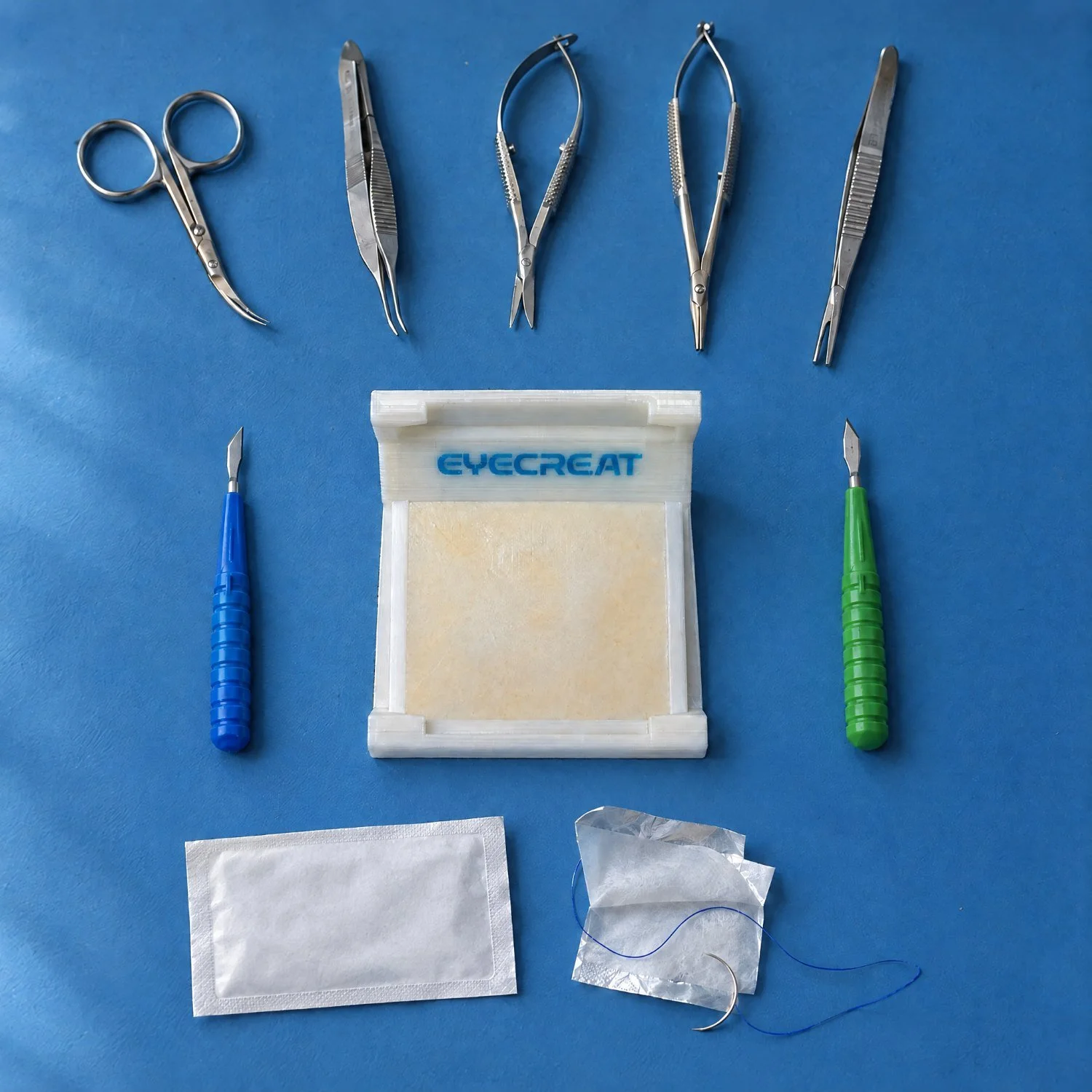
The Kit 4 Conjunctival Suturing is a complete training bundle for conjunctival closure: a reusable holder, a consumable training pad that mimics the thin, mobile conjunctiva, conjunctival forceps and scissors, Westcott scissors, needle holder, ligature forceps, two knives and two absorbable sutures (5/0 for the first exercises, 6/0 for finer work). One pad gives roughly four exercises; refill pads are 24 euros each (minimum 5). The kit costs 139 euros, or 185 euros with the MatPro 4 Eye base; the holder (49 euros) and the pads (24 euros each, minimum 5) are also sold separately. Made in Austria, shipped directly from Tyrol.
Why conjunctival suturing deserves its own training station
Ask a glaucoma surgeon what goes wrong after a trabeculectomy and the conjunctiva is near the top of the list. A buttonhole in the flap, a closure that is not watertight, a knot that erodes through: each of them turns a well executed filtration procedure into a leaking bleb, a flat chamber or a revision. The same closure sits at the end of tube shunt surgery, where the conjunctiva has to cover the plate and the tube without tension, and at the end of a peritomy for strabismus, pterygium or scleral buckling.[1]
The problem for training is the tissue itself. Conjunctiva is thin, it slides over Tenon's capsule, it tears when a forceps grabs it too hard, and the needle has to pass through two mobile layers that do not stay where you put them. A flat suturing pad made for skin teaches none of this. A pig eye teaches it, but only in a wetlab with a cold chain, and the conjunctiva on a pig eye is usually the first structure to be damaged when the eye is mounted.
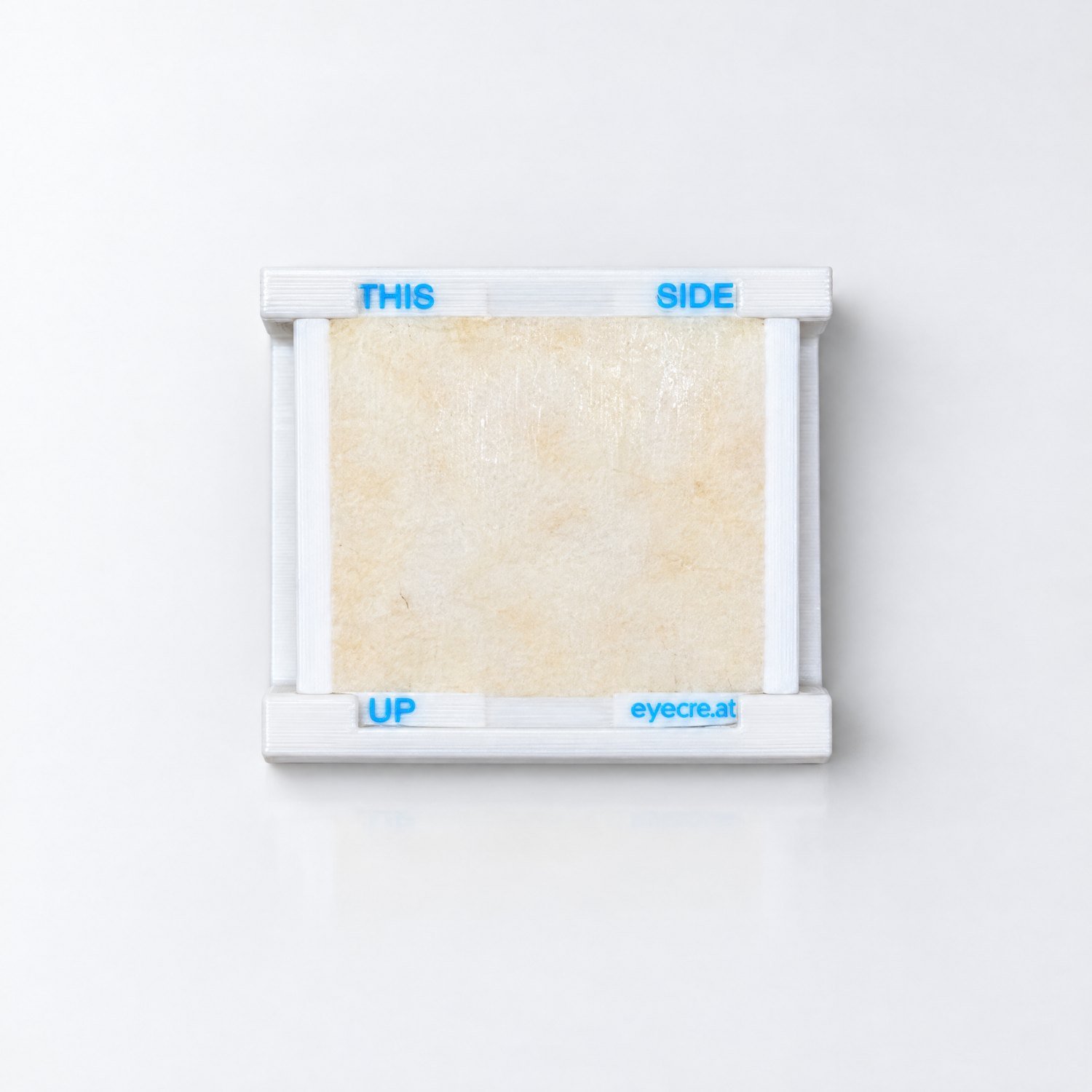
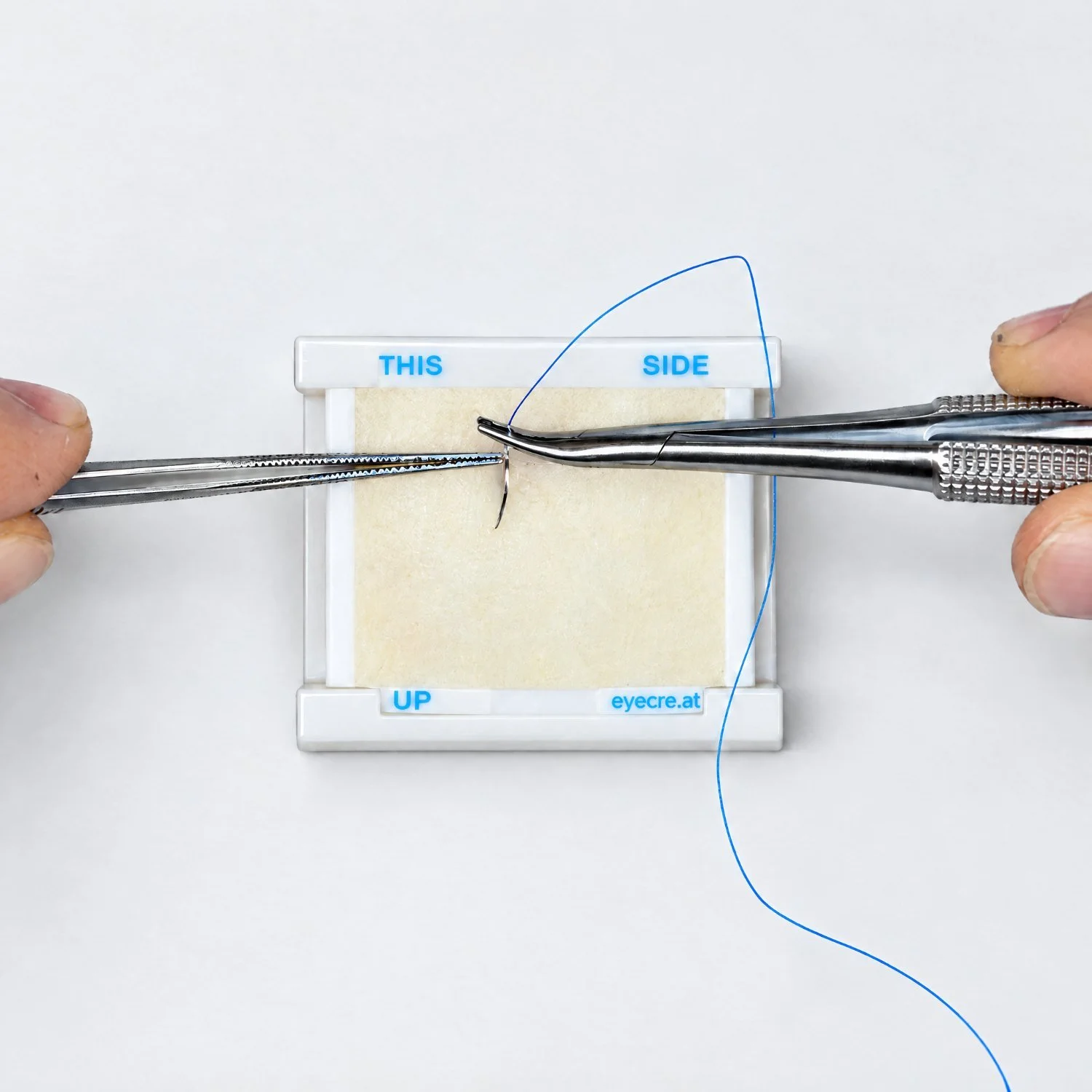
We built the Pad 4 ConjSuturing as a conjunctiva-like layer that can be sutured again and again on the bench. It is not an eye, and it does not pretend to be one. It is the part of the eye that residents need to suture most often and get to practise least, in a holder that keeps it still under the microscope.
The Kit 4 Conjunctival Suturing at a glance
| What it is | A complete bench station for conjunctival suturing: reusable holder, consumable conjunctiva pad, matching instruments, knives and absorbable sutures. Made in Austria by eyecre.at. |
|---|---|
| Pad | Pad 4 ConjSuturing, 40 x 35 x 2.5 mm, mimics the thin, mobile conjunctiva. About four suturing exercises per pad, depending on technique and how much surface you use. Refills in a minimum of 5 pads, each pad in a resealable bag.[3] |
| Holder | Holder 4 ConjSuturing, 45 x 40 x 20 mm, clips one pad firmly in place and attaches to the MatPro 4 Eye so nothing shifts under the microscope. Buy once, replace only the pads.[4] |
| Instruments | Conjunctival scissors, conjunctival forceps, Westcott tenotomy scissors, needle holder, ligature forceps |
| Knives | Angled crescent knife, straight 15 degree knife, for peritomy and conjunctival incisions |
| Sutures | 5/0 Surgicryl (braided, absorbable) for beginners, 6/0 Surgicryl Monofast (monofilament, absorbable) for advanced practice. Finer sutures from 7/0 to 10/0 are available as Sutures 4 Practice. |
| Procedures | Conjunctival closure with interrupted and running sutures, peritomy and flap handling, needle passage and knot tying on thin tissue, suture cutting and wound inspection |
| Price | Kit 4 Conjunctival Suturing 139 euros without, 185 euros with MatPro 4 Eye. Holder 49 euros, pads 24 euros each (minimum order 5).[2] |
| Shipping | Directly from Tyrol, Austria, worldwide. Delivery to most countries in 1 to 5 days when in stock. |
Setting up the station in 30 seconds
The holder clips onto the MatPro 4 Eye, the same silicone base that holds our artificial eyes, so a department that already has MatPro bases only needs the holder and pads. The pad snaps into the holder with the printed side up. From the box to the first suture takes about half a minute, which is why we filmed it as a short.
Conjunctival suturing practice in five exercises
This is the sequence we suggest for a resident who opens the kit for the first time. Each exercise builds one habit. Start with the 5/0 suture because you can see it, feel it and tie it without fighting the material; switch to 6/0 and finer once the needle pass is reliable. Use loupes or a microscope from exercise two onwards, because that is where the conjunctiva will be sutured in the OR.
- Grasp without tearing. Before any suture, pick up the pad edge with the conjunctival forceps and move it, release it, pick it up again. Then do the same with the Westcott scissors as a spreader. The habit is to hold the tissue by its edge, not its surface, and to let go as soon as the needle is through.Habit: gentle grasp at the edge, every time.
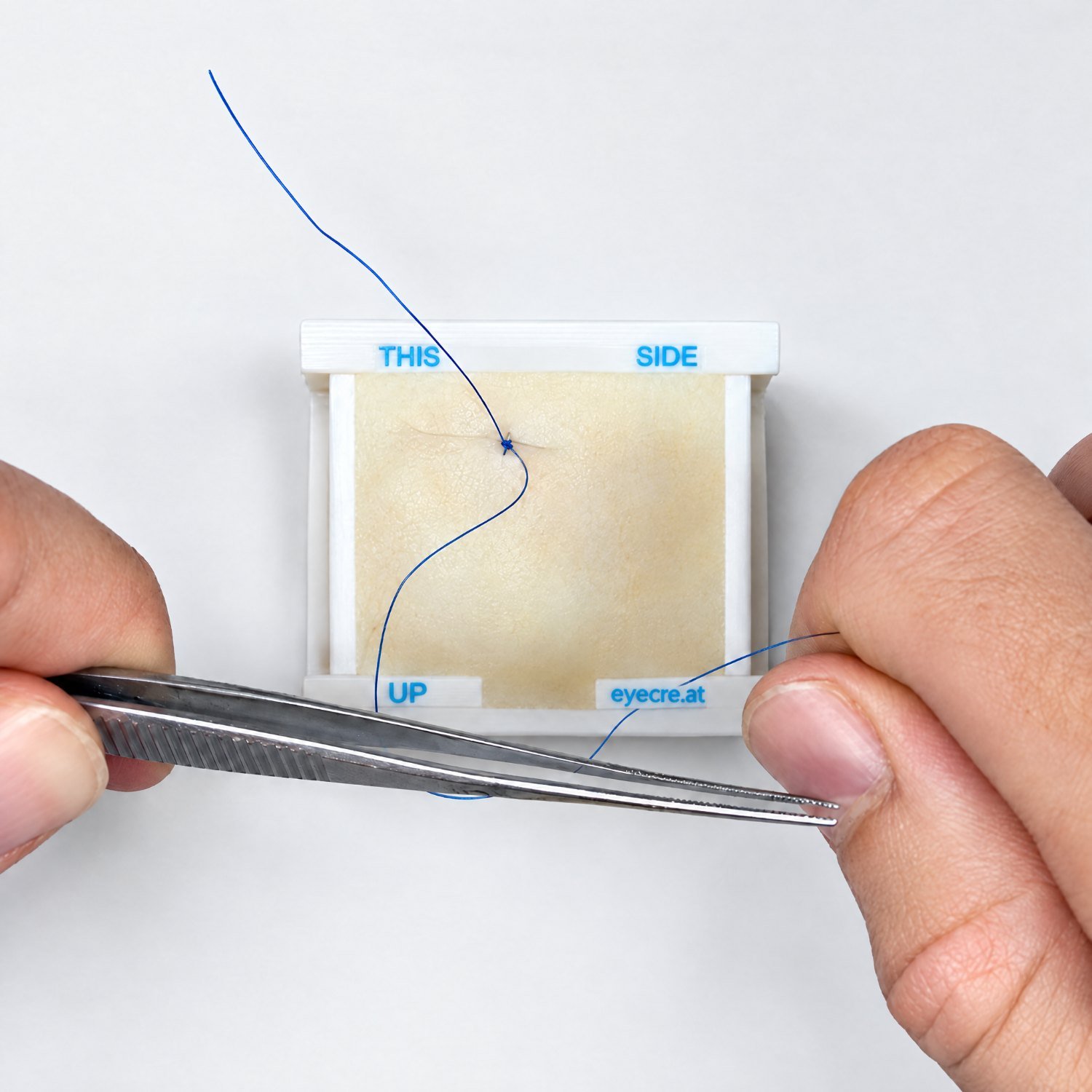
- The single interrupted suture. Make a 10 mm straight incision with the 15 degree knife. Place one 5/0 interrupted suture across it, enter 1 to 2 mm from the edge, pass the needle in one curve through both sides, tie a 3-1-1 knot and cut to 2 mm. Repeat along the incision until it is closed. Look at the knot: it should sit to one side of the wound, not on top of it.Habit: one needle pass, one curve, knot off the wound line.
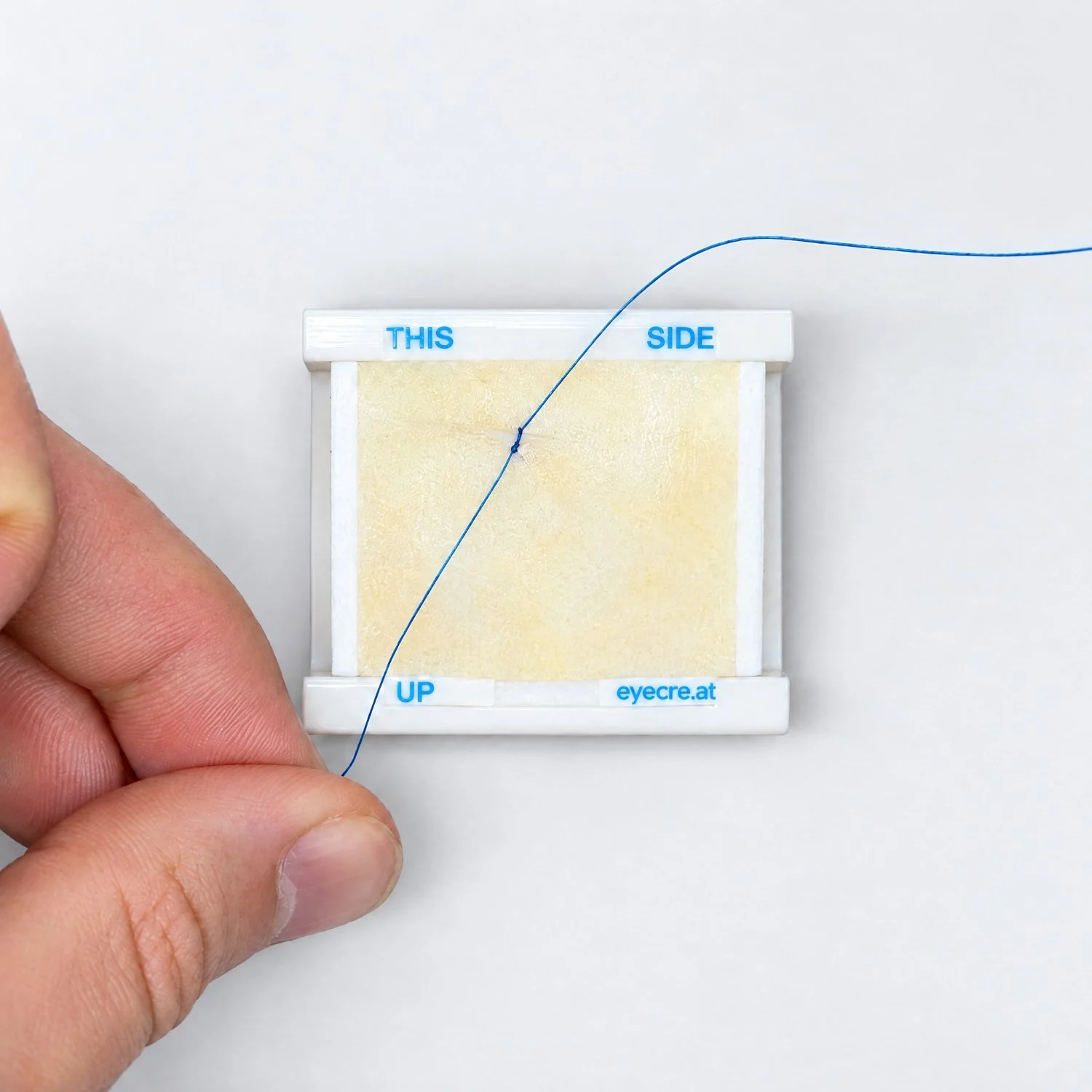
- The running closure. Make a second incision and close it with a running suture, locked or unlocked, in 6/0. The pad shows you immediately when tension is uneven: a tight bite puckers, a loose one gapes. Finish with a knot that lies flat, since a standing knot on the conjunctiva is what patients feel for weeks.Habit: even tension, flat knot.
- Peritomy and flap closure. Use the crescent knife to lift a curved flap as you would for a limbal peritomy, then reattach it with two or three interrupted sutures at the ends and a running suture between them. This is the closure of a trabeculectomy flap and of a tube shunt wound, where the flap has to come back to its origin without tension.Habit: anchor the corners first, then the length.
- Mattress suture and leak test. Close a wound with horizontal mattress sutures, the pattern used when a flap edge is friable or a watertight closure is critical. Then run a cannula along the wound with a drop of water on it: the wound should hold. If it does not, find the bite that is too shallow and replace it.Habit: check your closure before you leave the field.
Which suture for which exercise
In the OR, conjunctiva is closed with fine absorbable sutures, typically 8/0 to 10/0 depending on the surgeon and the procedure, and sometimes with nylon that is removed later.[1] For training we deliberately start thicker. A 5/0 suture is visible without magnification, the needle is easy to load, and a beginner can concentrate on the pass and the knot instead of hunting for the thread. Once the pass is reliable, the 6/0 monofilament behaves much more like the clinical suture: it is slippery, it needs a proper knot, and it shows every uneven bite.
| Suture | In the kit | Use it for |
|---|---|---|
| 5/0 Surgicryl | Yes, braided absorbable | Exercises 1 and 2. First needle passes, first knots, learning the grasp. The same suture we recommend for our eyelid models. |
| 6/0 Surgicryl Monofast | Yes, monofilament absorbable | Exercises 3 to 5. Running closures, flap repair, mattress sutures. Closest to clinical handling. |
| 7/0 to 10/0 | Separately, as Sutures 4 Practice | Advanced trainees and fellows who want the clinical calibre on the pad before they use it on a patient. |
Conjunctival suturing kept coming up in every conversation about glaucoma training. Surgeons told us the same thing: the trabeculectomy itself they could practise, the closure they learnt on patients. We wanted a product that lets you bring that one skill to the highest level without spending a fortune. A pad, a holder, the right instruments, and you can do it every evening.
What a conjunctival suturing station costs
The kit is the fast way to start. If your wetlab already has MatPro 4 Eye bases and instruments, holder and pads alone are enough. Prices as of October 2026, excluding VAT and shipping.[2]
| Option | Product | Price |
|---|---|---|
| Complete kit | Kit 4 Conjunctival Suturing, without MatPro 4 Eye | 139.00 euros |
| Complete kit with base | Kit 4 Conjunctival Suturing, with MatPro 4 Eye | 185.00 euros |
| Holder only | Holder 4 ConjSuturing, reusable | 49.00 euros |
| Refill pads | Pad 4 ConjSuturing, 24.00 euros per pad, minimum 5 pads (about 20 exercises) | 120.00 euros |
| Finer sutures | Sutures 4 Practice, 7/0 to 10/0 | per suture, see store |
| Next step | Set 4 Shunt for tube shunt implantation, or the glaucoma training guide for a full glaucoma wetlab | from 75.90 euros |
For course organisers. One kit per station plus one pad per participant covers a half-day conjunctival suturing workshop. Tell us the date and the number of stations and we plan production around your course; larger quantities take about two weeks. Residency programmes and departments can order on invoice through our B2B and residency page.
Frequently asked questions
How can I practise conjunctival suturing without patients?
Use a training pad that mimics thin, mobile conjunctiva, held still in a holder under loupes or a microscope, and work through interrupted sutures, running closures, flap repair and mattress sutures with absorbable sutures. The Kit 4 Conjunctival Suturing from eyecre.at bundles the pad, holder, instruments, knives and 5/0 and 6/0 sutures for exactly this; one pad gives about four exercises.
What is included in the Kit 4 Conjunctival Suturing?
Holder 4 ConjSuturing, one Pad 4 ConjSuturing, conjunctival scissors, conjunctival forceps, Westcott tenotomy scissors, needle holder, ligature forceps, an angled crescent knife, a straight 15 degree knife, a 5/0 Surgicryl suture and a 6/0 Surgicryl Monofast suture. The variant with MatPro 4 Eye adds the silicone base the holder attaches to.
How many exercises does one pad give?
Approximately four conjunctival suturing exercises per pad, depending on your technique and how much of the 40 x 35 mm surface you use. Refill pads are ordered in a minimum of 5, each individually packed in a resealable bag.
Which procedures does conjunctival suturing matter for?
Trabeculectomy and other filtering glaucoma surgery, where a watertight conjunctival closure prevents bleb leaks; tube shunt implantation, where the conjunctiva has to cover plate and tube without tension; and any procedure with a peritomy, such as strabismus surgery, pterygium excision, scleral buckling and scleral wound closure after vitrectomy.
Do I need the MatPro 4 Eye?
The Holder 4 ConjSuturing attaches to the MatPro 4 Eye so the pad does not shift under the microscope. If you already own a MatPro 4 Eye for your artificial eyes, choose the kit without it; otherwise choose the variant with MatPro 4 Eye.
Can I buy the holder and pads without the kit?
Yes. The Holder 4 ConjSuturing (49 euros) and the Pad 4 ConjSuturing (24 euros per pad, minimum 5) are sold separately in the eyecre.at store for wetlabs that already have instruments and sutures.
Is the model a medical device?
No. All eyecre.at training models are NOT FOR MEDICAL OR HUMAN USE, NON-STERILE AND ONLY FOR DEMONSTRATION. They are training and demonstration products, not medical devices.
Related guides
Other suturing and wetlab guides from eyecre.at:
- Corneal Suturing and Keratoplasty Practice on the Eye 4 Layered Cornea: the other suturing skill, on a curved cornea with a chamber behind it, including corneoscleral trauma where the conjunctiva is the last layer closed.
- Glaucoma and MIGS training guide: trabeculectomy, tube shunts and MIGS on artificial eyes, with the conjunctival closure at the end of each.
- Vitrectomy Wetlab Training: A Step-by-Step Guide to Practising PPV: the peritomy and scleral wound closure after trocar removal use the same sutures as exercises three and four.
- The Story of the M.A.R.K.O. LID: our eyelid model, where the same 5/0 suture is the beginner's suture for lid closure.
Sources
- American Academy of Ophthalmology, EyeWiki: "Trabeculectomy" and "Glaucoma Drainage Devices" (conjunctival closure, bleb leaks, suture materials). eyewiki.org
- eyecre.at store: Kit 4 Conjunctival Suturing, product page, contents and prices (139 euros without, 185 euros with MatPro 4 Eye). www.eyecre.at/store/p/kit-4-conjsuturing
- eyecre.at store: Pad 4 ConjSuturing, 40 x 35 x 2.5 mm, 24 euros per pad, minimum 5, about four exercises per pad. www.eyecre.at/store/p/pad-4-conjsuturing
- eyecre.at store: Holder 4 ConjSuturing, 45 x 40 x 20 mm, for MatPro 4 Eye. www.eyecre.at/store/p/holder-4-conjsuturing-pn0474
- eyecre.at YouTube channel: Holder 4 ConjSuturing setup and Pad 4 ConjSuturing test run. www.youtube.com/@eyecreat
Start conjunctival suturing practice this week
Kit 4 Conjunctival Suturing in the store Refill pads Ask us about a course wetlabAll images and videos show artificial training models. No patient, no real tissue. Product photos are staged product images of the real products. Text prepared with AI assistance and reviewed by eyecre.at. Prices as of October 2026, excluding VAT and shipping. eyecre.at training models: NOT FOR MEDICAL OR HUMAN USE, NON-STERILE AND ONLY FOR DEMONSTRATION.